Service
Gutter Installation Service
See how a new system is measured, sized and fitted, with the scope and price range in writing.
See prices and detailsWater leaves a metal roof faster and harder than it leaves shingles, and that changes the sizing, the profile and the way a system is fixed on. This guide covers the choices that matter before any fitting starts.
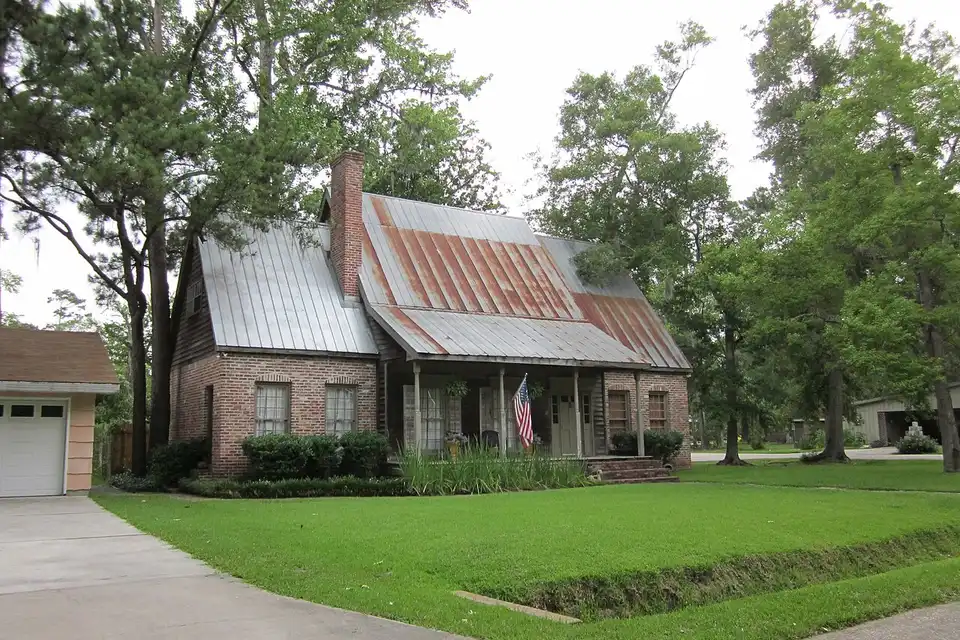
Photo: Mandeville House Metal roof by Infrogmation of New Orleans, via Wikimedia Commons, CC BY 3.0.
A metal roof changes the water problem at the eave. Shingles slow rain down with texture and grit. A smooth metal surface lets it gather speed, and it arrives at the edge as a fast, heavy sheet that can overshoot a standard channel entirely. Choosing gutters for metal roof homes is therefore less about style and more about keeping up: the right size, the right profile, hangers fixed without harming the roof, and a plan for snow sliding off that same smooth surface.
Most metal roof homes need a 6 inch channel rather than the standard 5 inch, larger 3 by 4 inch downspouts, and hangers clamped to standing seams or fixed to the fascia instead of screwed through the panels. Set the channel slightly lower than on a shingle roof so fast runoff drops in instead of overshooting.
Size is the first decision, and on metal the answer usually steps up. A 6 inch channel holds more water and presents a wider target for a fast sheet of runoff leaving the roof edge. Pair it with 3 by 4 inch downspouts so the outlets drain the channel as fast as the roof fills it. On a small, low pitch metal roof over a porch, a 5 inch channel with standard 2 by 3 inch downspouts can still be enough, and a good installer will say so rather than upsizing everything by reflex.
Profile is the second decision. K style channels carry a lot of water for their size and are the common pick. Half round channels in a matching finish suit traditional and historic homes, hang from brackets that suit exposed eaves, and shed debris well thanks to their smooth curve. Either profile works on metal when it is sized right. What fails is a small channel of any profile, hung high and tight, meeting water that arrives faster than the shingle roof next door ever sends.
The fitting questions matter more on metal than on any other roof. Screwing hangers through the panels makes holes in a roof whose whole value is being a sealed metal skin, and it can void the roof warranty. On standing seam roofs, the standard answer is clamps that grip the raised seams and carry the hanger brackets, with no new holes at all. Where seams are not available, brackets fix to the fascia board, and the channel hangs from the wall of the house rather than the roof surface.
Ask your installer which method your roof gets, and write the answer into the quote. The step by step fitting work itself, measuring, cutting, joining and sealing, is covered in our guide to how to install gutters, including the section on metal roofs. This article stays on the choices you make before that work starts, because on a metal roof the wrong fixing choice cannot be undone once the screws are in.
Water leaving a metal roof carries speed, and speed means it lands farther out than water dripping off shingles. Crews who fit metal roofs set the channel a little lower on the fascia and check the drip edge line carefully, so the sheet drops into the channel instead of jumping it. In heavy rain you can see the failure at once on a badly set system: a bright line of water arcing clean over the channel and pouring down the wall.
Slope still follows the standard rule, about 1/4 inch of fall per 10 feet toward the downspout, but the long, straight runs metal roofs often have make slope errors more visible. A run that ponds in the middle will overflow at the pond in a storm surge. Ask how the crew checks slope before they leave, and whether they water test each run. A hose test on the day is worth more than a promise.
The same smoothness that speeds rain also releases snow in slabs. A sliding slab can bend a channel, tear hangers out, or take the whole run down in one event. Snow guards fitted on the roof above the eave break the slide into smaller, slower pieces, and in snow country they are part of the gutter conversation, not an extra. Hangers fitted closer together and set slightly lower share the load better than a standard spacing hung high in the slide path.
Ice in the channel itself is the second load. A system that drains fully, at the right slope, with outlets big enough to clear melt water, spends less of the winter holding ice. When you compare quotes, ask each installer directly what their snow plan is. A specific answer, guards, spacing, position, means they have fitted metal roofs through winters before. A shrug means your house is their lesson.
The published range for a new system is $12 to $25 per foot installed, or $2,200 to $5,000 per home for most houses, and metal roof homes often sit toward the upper part because of the larger channel, larger downspouts and seam clamp hardware. Read that range as a guide: the actual price for your home is decided after measuring, and given as an itemized written quote fixed before work starts, with the hanger method listed as its own line so you can see there are no screws planned through your panels.
When you are ready to compare a full scope, the gutter installation service page sets out what a proper fitting includes. Bring this article's questions to that conversation: size, downspout size, fixing method, snow plan and water test. The installer who answers all five plainly is the one whose system will still be hanging straight after the first winter slide.
See how a new system is measured, sized and fitted, with the scope and price range in writing.
See prices and detailsRain chains, drip edges and dispersal systems compared, with honest notes on where each one falls short.
Read the guideWhat a working system protects, from fascia boards to foundations, and when a house can skip one.
Read the guideWhich faults a repair fixes, which faults mean starting over, and how to compare the two quotes.
Read the guideBrowse every guide on the Gutter Cleaning HQ blog, grouped by topic.
Often, yes. On standing seam roofs, clamps grip the raised seams and carry the hangers without any new holes in the panels. On other profiles, brackets can fix to the fascia board instead. Ask which method a crew plans for your roof, because drilling through panels can void the roof warranty.
Usually, yes. The channel can only drain as fast as its outlets allow, and fast runoff off a smooth roof arrives in surges. The larger 3 by 4 inch downspout is the common pairing with a 6 inch channel on metal roofs, where the standard 2 by 3 inch size becomes the bottleneck in heavy rain.
It can, if the system is hung high in the snow path with weak hangers. Snow guards on the roof slow the slide, hangers fitted close and low reduce the pull on each bracket, and strong brackets matter. In snow country, ask about all three together rather than treating the channel as a standard shingle roof job.
The metals need to be compatible, not identical. Some metal pairings react where they touch and stain or corrode each other over time, so the channel, hangers and fasteners should be chosen with the roof material in mind. A crew fitting metal roofs regularly will name the pairing without being asked.
Ask for the sizing, hanger method and snow plan in writing before work starts. On a metal roof, those three lines matter more than the brand of metal.
Call +1 (888) 295-0648