Service
Gutter Installation Service
See how a standard system is sized and fitted, so you can compare it fairly against any substitute.
See prices and detailsChains, drip edges, dispersal panels and gravel trenches all promise a house without channels to clean. Each one handles some roof water well and some badly. This guide grades them job by job, fairly.
Some owners hate cleaning channels. Some hate how they look. Some have been quoted for a full system and want a cheaper answer. Whatever brought you here, the honest search for gutter alternatives starts with one fact: a roof sheds a lot of water, fast, and every substitute has to answer the same two questions a channel answers. Where does the water go, and what does it hit on the way down? Grade each option below against those two questions and the marketing falls away.
Rain chains, drip edges, dispersal systems and ground trenches each handle part of the job. None of them collects and moves water away from the house the way a channel and downspout does. They work best in dry climates, over beds and gravel, and on homes with wide eaves and good grading.
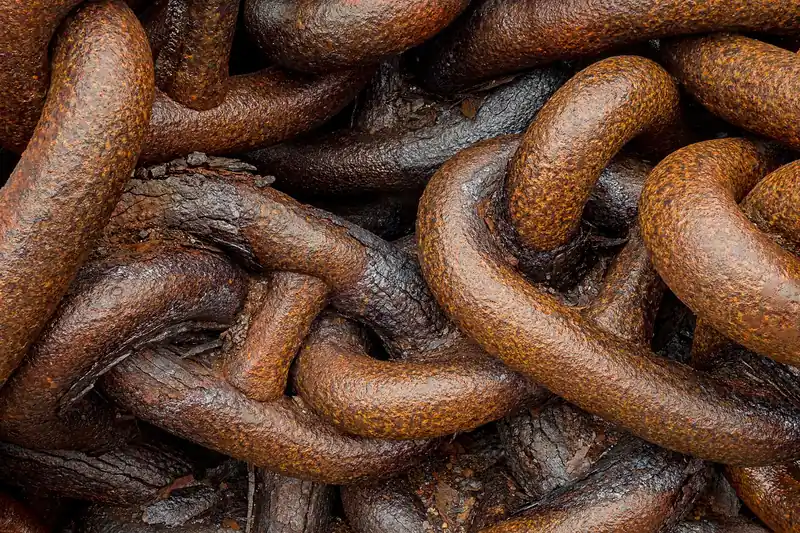
Rain chains. A chain hangs from a hole in the eave where a downspout would sit, and water clings to the links and runs down into a basin, barrel or splash stone. In gentle rain it works and looks good doing it. In a downpour the flow outruns the chain, sprays sideways, and soaks the wall base. Chains are a fair rain gutter substitute at a sheltered corner over a planted bed, and a poor one over a walkway or beside a basement window.
Drip edge. This is not a substitute so much as a partner. The metal strip at the roof edge pushes drips clear of the fascia so the wood stays drier, and every good roof should have one. But the water still falls in a sheet to the ground below. Fit drip edge to protect the roof edge, by all means, and then solve the ground problem separately.
Rain dispersal systems. Sold under names like rain handlers, these are louvered panels fitted at the eave in place of a channel. They break the falling sheet into droplets and spread them outward, so water lands as spray across a band of ground instead of a trench line. There is nothing to clean and nothing to clog. The limits are real: wind blows the spray back onto siding, heavy flows overshoot, ice builds on the louvers in cold areas, and the water still lands near the house, just spread out.
The oldest alternative to gutters is managing the water after it lands. A drip path is a planned strip along the drip line: gravel over drainage fabric, a shallow swale, or a buried channel that catches the fall and carries it away from the foundation. Done properly, with soil graded away from the house and the trench draining to a lower point, it protects the foundation surprisingly well for very little money.
What ground work cannot do is stop the fall itself. Siding still takes splash back in every storm, mud still spatters the lower wall, and anyone walking out of a door under the eave still steps through a curtain of water. Ground channels also need their own care: gravel fills with soil and leaves over time, and a trench that no longer drains is just a moat holding water against the wall.
Notice the pattern: substitutes work where the water problem is already small. Where the problem is large, heavy rain, clay soil, a basement, a roof valley dumping onto one spot, each substitute gives back a piece of the job it cannot do, and the pieces add up to the damage a channel prevents.
Many owners hunting for a substitute are really hunting for less cleaning. The fair middle answer is a plain open channel, no guards or covers to trap debris, paired with larger downspouts, 3 by 4 inch instead of the standard 2 by 3 inch. Bigger outlets pass leaves and seed pods through instead of plugging, the open channel is easy to scoop and rinse, and the system still collects water and moves it away from the house, which no substitute fully does.
Pricing that honest option helps the comparison. A new system costs $12 to $25 per foot installed, or $2,200 to $5,000 per home for most houses. Treat the range as a guide: the actual price is decided after measuring the home, and given as an itemized written quote fixed before work starts. Set that known figure against the cost of trenching, chains and repairs to splash damaged siding over the years, and for many homes the channel wins on money as well as on dryness. If you want the full scope, the gutter installation service page shows how a standard system is put together.
Stand outside in your next hard rain and watch your drip line. Note where water lands, how far the splash reaches up the wall, where puddles sit an hour later, and whether any door or window well takes a direct fall. Then grade the option you favor against that storm, not against a light shower. If a chain or panel would have handled what you just watched, on your soil, with your grading, choose it in good conscience. If the storm showed water doing damage in three places at once, you have your answer too, and it is the channel.
See how a standard system is sized and fitted, so you can compare it fairly against any substitute.
See prices and detailsWhat a working system protects, from fascia boards to foundations, and when a house can skip one.
Read the guideWhich faults a repair fixes, which faults mean starting over, and how to compare the two quotes.
Read the guideSizing, profile and hanger choices for fast runoff off a metal roof, and the fitting details that matter.
Read the guideBrowse every guide on the Gutter Cleaning HQ blog, grouped by topic.
In light and moderate rain, a well placed chain guides water down neatly into a basin or splash area. In a heavy downpour, water moves too fast to cling to the chain and sprays off it, soaking the wall base nearby. Chains suit sheltered spots and moderate climates better than exposed walls in storm country.
No. A drip edge is a metal strip under the first course of shingles that pushes drips clear of the fascia. It protects the wood at the roof edge, which is valuable, but the water still falls to the ground in a line along the wall. Foundation protection needs collection or grading, not just a cleaner drip.
Usually grading and ground work: soil sloped away from the house, a gravel drip trench along the drip line, and splash blocks or short channels where downspout points would be. That manages where water lands for little money, but it does not stop splash back on siding or a curtain of water over doors.
A valley concentrates a lot of water into one fast stream, and that is where dispersal panels struggle most. The stream can overshoot the louvers and land as a jet beyond the panel. Valleys are the strongest case for a standard channel and downspout, sized for the extra flow the valley delivers.
Bring your roof shape, your rainfall pattern and the spots that suffer now. The right choice, channel or substitute, follows from those three facts.
Call +1 (888) 295-0648