Service
Gutter Installation Service
New systems formed and fitted on site, with sizes and materials matched to your roof.
See prices and detailsProfile is the shape you see from the street, material is what the metal is, and size is how much water the system can move. This guide keeps the three separate so choosing gets simple.
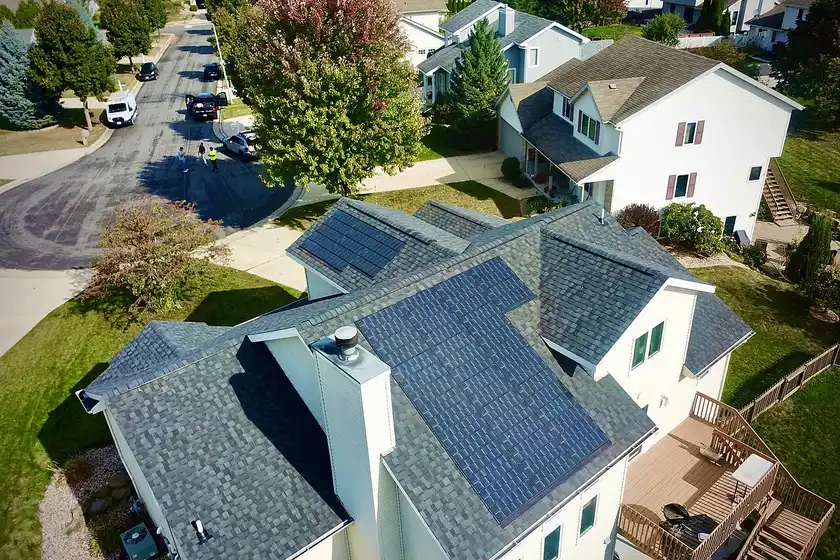
Photo: Solar shingle roof CertainTeed Solstice Madison WI Sun Vault by Sun Vault Roofing, via Wikimedia Commons, CC BY-SA 4.0.
Homeowners use one word, gutters, for three separate choices. The types of gutters on a house are set by profile, the cross section shape you see from below; by material, the metal or plastic the channel is made from; and by construction, whether the runs arrive in short sections or are formed in one long piece on site. Separating those three choices turns a confusing catalog into a short, clear decision.
Most US homes wear K style aluminum gutters in 5 inch size, formed seamlessly on site. Half round profiles suit older and high end homes. Box profiles serve large and commercial roofs. Fascia style systems double as the roof edge board. Material and size matter as much as shape: match all three to your roof and rainfall.
K style is the default on modern homes. The back is flat, so it mounts directly against the fascia board, and the front face is bent into a stepped shape that looks a bit like crown molding from the street. That shape is not just decoration. It stiffens the front edge and gives the channel more capacity than a round profile of the same width, which is one reason it took over the market.
Half round is the older shape: a smooth half circle, hung from brackets rather than nailed flat. It drains cleanly because there are no corners for grit to lodge in, and it suits historic homes and high end builds where the roofline is part of the look. Box profiles are large rectangular troughs, often built into the roof edge itself, common on commercial buildings and older city homes. Fascia gutters replace the fascia board entirely with a tall profile that carries water and finishes the eave in one piece, mostly on homes built without separate fascia boards.
Ask what are gutters made of and aluminum wins the count by a mile. It is light, it does not rust, it takes paint well, and roll forming machines turn a flat coil of it into seamless runs in your driveway. Most aluminum gutter stock comes in two thicknesses, and the thicker grade resists ladder dents and ice load better in cold states.
The other materials each own a niche. Vinyl is cheap and never rusts, but it turns brittle in cold winters and sags in hot sun, and it comes only in short sections with many joints. Galvanized steel is strong and takes knocks, but its coating eventually gives way to rust, starting at cut edges and seams. Copper is the premium choice, soldered at the joints, bought for looks and very long service on homes where the roofline shows. Zinc and stainless steel appear on custom work. Wood survives on a small number of historic restorations, where the original material is part of the building record.
Profile means little without size. The standard residential widths are 5 inch and 6 inch, measured across the top of the channel. Five inch suits most roofs. Six inch earns its price on large roof areas, steep pitches and places with hard downpours, because a bigger channel holds a surge instead of spilling it. Downspouts must match the choice: the standard sizes are 2 by 3 inch and 3 by 4 inch, and a wide channel drained by one narrow spout is a bottleneck wearing a bigger hat.
Construction is the third choice. Sectional systems join stock lengths with connectors every 10 to 15 feet, and every joint is a future leak point that sealant must hold. Seamless runs are formed to length on site, so joints exist only at corners and outlets. For a full replacement, seamless is the usual recommendation in the trade. For a short repair or a small outbuilding, sections keep the job cheap and simple. When you price a system, our gutter installation service page shows the fitting process and what a crew handles on site.
Published ranges for installation and replacement run $12 to $25 per foot installed, or $2,200 to $5,000 per home for a typical full job. Seamless work on its own is often quoted at $6 to $20 per foot depending on profile and metal. Aluminum K style sits at the low end of those bands. Copper, large box profiles and half round systems with their separate brackets sit well above them, and access, height and corners move any quote.
Treat those figures the honest way. A published range is a guide for planning, and the actual price for your home is decided after measuring the roofline, and given as an itemized written quote fixed before work starts. The quote should name the profile, the size, the metal and its thickness, the number of downspouts, and the hanger spacing, so you can compare two quotes line by line instead of guessing which one left something out.
Start with the house, not the catalog. A historic home with an exposed roofline usually calls for half round in a metal that suits its age. A typical suburban two story is served best by 5 or 6 inch K style aluminum, sized by roof area and rainfall. A wide, low commercial style roof or an older home with a trough built into the eave needs box profile thinking and a crew that knows built in work.
Then check the practical details. Guards fit K style channels most easily, because the flat top takes standard covers. Steep roofs and big roof planes push you up a size. And whatever profile you choose, slope still rules the result: runs are pitched at about 1/4 inch per 10 feet toward the downspouts, because no shape drains well standing level. Get profile, material, size and slope right together, and the system quietly does its job for decades.
New systems formed and fitted on site, with sizes and materials matched to your roof.
See prices and detailsSizes, capacity and hangers for the flat back profile most houses wear.
Read the guideThe smooth half circle profile: where it shines, what it costs, where it struggles.
Read the guideWhy aluminum became the default metal, and when to choose something else.
Read the guideBrowse every guide on the Gutter Cleaning HQ blog, grouped by topic.
The K style profile, by a wide margin. Its flat back mounts straight to the fascia and its shaped front holds more water than a round profile of the same width. Most replacement work copies it because hangers, corners and downspout parts are stocked everywhere in both 5 inch and 6 inch sizes.
Only if the downspouts grow with it. A 6 inch channel fed into one small 2 by 3 inch downspout still drains at the speed of that spout. Bigger profiles help most on large or steep roofs, and the usual pairing is a 6 inch channel with 3 by 4 inch downspouts so the whole path is wider.
Yes, replacement is exactly when owners change shape. The fascia must be sound and the new profile must suit the roof edge and any guard you plan to fit. Half round systems need different hangers and brackets, so the change costs more than swapping like for like in the same profile and size.
Seamless runs have joints only at corners and downspouts, so there are far fewer seams to leak. They are formed on site to the exact length of the roofline, in K style and half round profiles. Sectional systems use short stock lengths joined every 10 to 15 feet, which suits small repairs and home fitting.
We will measure your roof, size the runs and downspouts, and give an itemized written quote for the profile that fits your home.
Call +1 (888) 295-0648