Service
Gutter Installation Service
New systems formed and fitted on site, with sizes and materials matched to your roof.
See prices and detailsThe oldest gutter shape still in use, kept alive by historic streets and high end roofs. It drains beautifully, costs more to hang, and holds less than its squared rival.
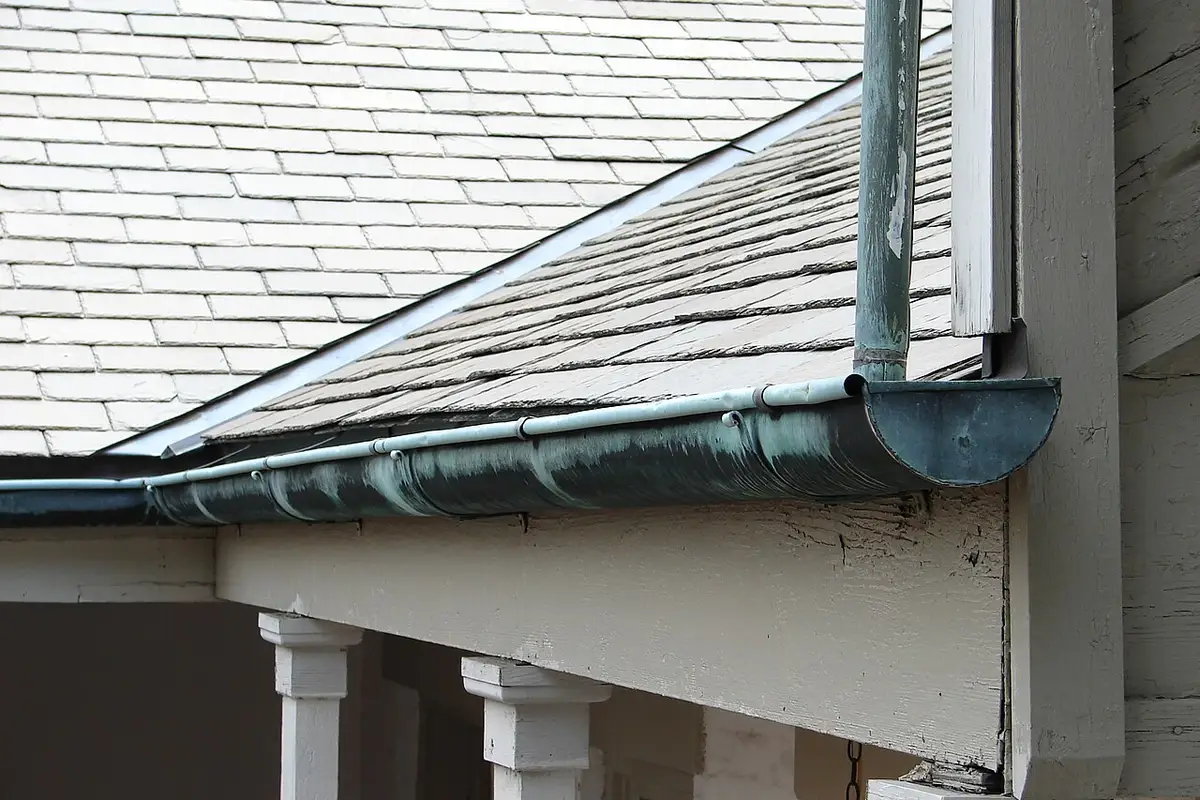
Photo: Gutter 1850s House New Orleans by Mark Gstohl, via Wikimedia Commons, CC BY 2.0.
Before the squared profile took over suburbia, the half round gutter was the gutter: a simple half circle of metal hung under the eave, the same shape found on farmhouses, brick colonials and 19th century main streets. It never disappeared. It retreated to the homes where looks and history matter most, and on those homes it still looks so right that owners pay a premium to keep it.
A half round gutter is a smooth half circle channel, usually 5 or 6 inches wide, hung from brackets instead of mounted flat. It drains and rinses cleanly, suits historic and high end homes, holds less water than a K style channel of the same width, and costs more to buy and hang.
The physics are the selling point. A round bottom has no inside corners, and corners are where grit, seeds and sludge settle and start a clog. Water moving through a half round gutter keeps its speed and carries fine material toward the downspout instead of dropping it along the way. After a storm, the channel rinses nearly clean on its own. Round outlets and smooth elbows help as well, because every turn in the flow path is a spot where a squared corner would slow the water down and leave a line of grit behind once the rain has passed. Owners who clean both shapes on different buildings notice the difference at once: the round runs hold a thin film, the squared runs hold ridges in the corners.
The tradeoff is volume. A half circle is the least roomy shape for its width, since the bottom half of the circle is missing by design. A 6 inch round channel carries roughly what a 5 inch squared channel does. On big roof planes and in hard rainfall regions, that means sizing up, adding downspouts, or accepting the squared profile. Slope still matters just as much: runs pitch at about 1/4 inch per 10 feet toward the outlets, round or not.
Historic homes are the natural home of this profile, sometimes by rule. Preservation districts and older deed restrictions can require the original profile at the eave, and even where no rule applies, a squared modern channel looks wrong on a slate roofed colonial or a Victorian with exposed rafter tails. High end new builds choose it for the same reason in reverse: the clean curve and the visible brackets read as craft, not commodity.
It also suits homes where the gutter is meant to be seen. A round channel in copper, hung on neat brackets, becomes part of the architecture. On a plain suburban two story where the gutter is background, the same money buys no visible gain, which is why the squared profile owns that market. Fit here means matching the channel to the roofline story the house is already telling.
Hanging is where this profile spends its extra money. There is no flat back to screw through, so the channel rests in brackets that cradle it from below, or hangs from straps fixed over the roof edge or to the fascia. Each bracket must be set on the slope line, and spacing runs closer than on a flat back run, because the channel can roll or shift in a loose cradle.
Corners, end caps and outlets are profile specific parts, formed or cast for the curve. A crew that mostly hangs squared gutters can fit round work well, but it takes them longer, and the parts cost more before anyone climbs a ladder. If you are gathering quotes, our gutter installation service page sets out what a complete installation quote should itemize, brackets included.
General published ranges for installation and replacement run $12 to $25 per foot installed, or $2,200 to $5,000 per home, and this profile in aluminum usually lands in the upper part of that band once brackets and parts are counted. In copper it lands well above the band, sometimes several times above, which owners accept because soldered copper work is bought once for a very long service life.
Use the ranges the way they are meant. A published range is a planning guide, and the actual price for your home is decided after measuring the rooflines, and given as an itemized written quote fixed before work starts. On round work especially, make sure the quote names the bracket type and spacing, the metal, and the downspout size, since those are the lines where cheaper quotes quietly thin out.
Capacity is the first weak spot, covered above: size up or add downspouts on large roofs. Guards are the second. The guard market is built for the flat topped squared channel, so covers for a round profile are fewer, and fitting must be checked panel by panel. The third is plain availability: fewer crews stock the parts, so a storm damaged corner may wait days for the right miter instead of coming off a shelf.
None of that outweighs the fit on the right house. A half round gutter drains cleanly, ages gracefully in the right metal, and keeps an older roofline honest. Choose it for looks, history and smooth drainage, with eyes open about capacity and cost, and it will serve as quietly as the squared profile serves the rest of the street.
New systems formed and fitted on site, with sizes and materials matched to your roof.
See prices and detailsEvery common profile and material compared, so you can place this shape in context.
Read the guideSizes, capacity and hangers for the flat back profile most houses wear.
Read the guideLarge troughs built into roof edges on historic homes and commercial roofs.
Read the guideBrowse every guide on the Gutter Cleaning HQ blog, grouped by topic.
Yes. Because the back is curved, it cannot screw flat to the fascia like a K style run. It hangs from brackets that cradle the bottom of the channel or from straps fixed at the roof edge. Brackets cost more and take longer to set level, which is part of the higher fitting price.
Yes, forming machines roll this profile in aluminum and copper in long runs, so joints appear only at corners and outlets, just like other seamless work. The corner pieces and outlets are profile specific, so a crew orders them ahead rather than cutting them from flat stock at your home.
It is a harder match. Most guards are designed for the flat topped K style channel, so options narrow to screens and mesh made to sit on the curved profile, often clipped to the front bead. Ask to see the exact guard fitted on a sample length before you commit to both at once.
Copper is the classic pairing and is soldered at the joints for a very long service life. Aluminum is the practical choice for painted work, and galvanized or painted steel appears on older systems. Vinyl versions exist in some stores but lack the smooth strength that makes this profile worth choosing.
We will size the profile, source the right brackets and metal, and give an itemized written quote before any work starts.
Call +1 (888) 295-0648