Service
Gutter Repair Service
Sagging runs refixed, loose hardware replaced and slope reset, with the price in writing first.
See prices and detailsThe channel gets the attention, but the small brackets inside it do the holding. Get the type and the spacing right, and a run stays straight for years. Get them wrong, and it sags.
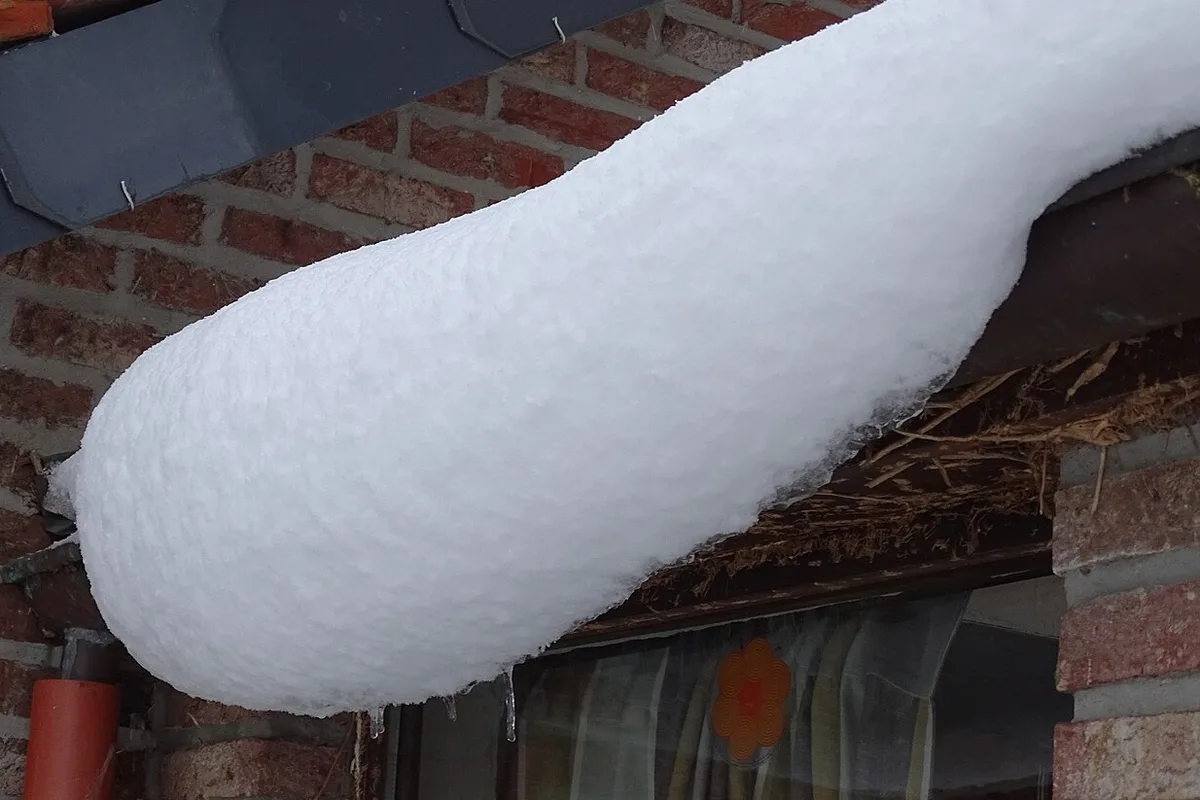
Photo: Overhanging snow and icicles 05 by Ad Meskens, via Wikimedia Commons, CC BY-SA 4.0.
Most gutter failures that look like channel failures start with the hardware. The run dips in the middle, water pools instead of flowing, and the front edge spills in every storm. In case after case the metal trough is fine and the gutter hangers have bent, rusted or pulled loose from the fascia. This guide covers the hardware itself: the types in use, the spacing that keeps a run straight, and the loads each bracket has to carry.
The small brackets inside or over the channel carry the whole run. Hidden brackets with screws hold best for most homes. Space them no more than 24 inches apart, and closer, at 16 to 18 inches, where snow and ice add weight or the run is long and straight.
The hidden hanger is the modern standard for K style channels. It sits inside the trough, hooks over the front lip, and a long screw drives through its back plate into the fascia and, on many homes, the rafter tail behind it. Nothing shows from the ground, the screw can be backed out and reset, and the bracket resists the downward pull of a full, heavy run better than older fixings.
The spike and ferrule is the older method. A tube called a ferrule sits inside the channel to hold its shape, and a long spike passes through the front lip, the ferrule and the back of the channel into the wood. Spikes are fast to fit, but they work loose as wood swells and shrinks, and a backed out spike is one of the most common sights on an aging system.
Strap hangers, also sold as roof straps, solve a real problem on homes with thin, angled or missing fascia boards. The strap runs up the roof slope and fixes to the deck, so the load hangs from the roof structure rather than a weak board edge. They take longer to fit, since shingles or flashing must be lifted, but on the right house they are the only honest fixing.
The working rule is simple: no more than 24 inches between brackets on a standard run. Owners asking how many gutter hangers per 10 feet get a short answer: at least five, and six is better. Ends, corners and the spots beside each outlet need a bracket close by, because those points carry joints and the extra pull of dropping water.
Close the spacing up where loads grow. In snow and ice country, 16 to 18 inches is the sound range, because a run can carry a slab of snow and a channel full of ice at the same time. Long straight runs, 6 inch channels, and roof valleys that dump heavy flow into one short section all belong at the closer spacing too. Wide spacing saves a handful of brackets on fitting day and pays for it with a sagging run a few winters later.
Spacing works together with slope. A run falls about 1/4 inch over every 10 feet toward its outlet, and each bracket sets one point of that line. One bracket set a little high or low makes a shallow pool that holds water, grit and ice. For the full fitting task, from setting the line to fixing each bracket in order, see our step by step guide to how to hang gutters with the right slope.
Water is heavier than it looks. One gallon weighs about 8.3 pounds, and a long run in a storm can hold many gallons at once, on top of wet leaves and grit that never drained. Add a slab of snow sliding off the roof and resting on the channel, as in the photo at the top of this page, and a single bracket may be holding a serious load for days at a time.
Ice is the harshest test. Water trapped by a small dip freezes, expands, and pries at brackets and seams night after night. That is why spacing and slope matter more in cold states than in mild ones, and why a run that looks fine in July can be pulled out of line by March. Hardware rated for the channel size, fixed into solid wood, is what carries a system through those cycles.
Weak fascia is the hidden limit. A strong bracket screwed into rotted board holds nothing. Fitters test the board along the run first, and soft sections get cut out and replaced before new hardware goes in. Skipping that step is how a freshly refitted run ends up on the ground after the first heavy storm.
Failure shows early, if you know where to look. A run that dips between fixings, a front lip that tilts outward, spikes sitting proud of the channel face, and rust streaks below one bracket all say the same thing: that section is no longer held. Inside the house there are no signs at all, which is why this fault gets missed until overflow starts marking the siding and soaking the ground by the foundation.
One or two failed brackets on an otherwise sound run is a small job: the section is lifted, the faulty pieces come out, and new screw brackets go into solid wood at tighter spacing. A whole elevation of loose spikes on rotted fascia is a bigger conversation, closer to refitting that side of the house. The honest dividing line is the board and the channel, not the brackets. Sound metal and sound wood mean the hardware fix will hold.
Refixing a sagging section, swapping failed spikes for screw brackets, or resetting slope along one wall sits inside the normal repair range of $100 to $450 per job. The price moves with height, length of run, and whether fascia wood needs repair before anything can be screwed into it. Two story work and long runs sit at the upper end, as ladder time grows.
Read any published range as a guide for planning, not a promise for your house. The actual price is decided after the run is measured and the board is checked, and it should come back to you as an itemized written quote fixed before work starts. Our gutter repair service page sets out what a visit covers and how the written price is built.
One last buying note. When two quotes differ, ask each fitter which bracket type and what spacing the price assumes. A quote built on wide spacing and spikes is cheaper for a reason, and the reason shows up in the first hard winter. The better question is never just the total. It is what is holding your run up, and how far apart.
Sagging runs refixed, loose hardware replaced and slope reset, with the price in writing first.
See prices and detailsEvery piece of the system named in order, from end caps and miters to outlets and elbows.
Read the guideHow width and profile change capacity, and when a bigger channel is the right call.
Read the guidePicking a sealant for seams and corners, and laying a bead that does not peel by spring.
Read the guideBrowse every guide on the Gutter Cleaning HQ blog, grouped by topic.
Rarely with good results. A spike that has pulled out once has usually enlarged its hole in the fascia, so it works loose again within a season or two. A screw driven bracket bites into fresh wood beside the old hole and holds far longer, which is why most refits swap spikes for screws.
Half round profiles sit in curved brackets rather than clipping to an inside bracket. The bracket either fixes to the fascia or hangs from the roof edge on a rod or strap. Spacing follows the same load rules, and the brackets must match the exact curve of the channel or the run rocks in its cradle.
Look along the run from one end. A straight run reads as one clean line. Dips, a front lip that sits lower in the middle, or a gap opening between channel and fascia all point to bent or loose hardware. Water marks below one spot after rain confirm that section is spilling.
Yes. A 6 inch channel carries more water than a 5 inch one, so each bracket carries more weight when the run is full. Wide channels, long straight runs and roofs that dump heavy flow into one section all argue for spacing at the closer end of the range, not the widest.
That is hardware talking. Send a photo along the run and we will say what has failed and give an itemized written quote before any ladder goes up.
Call +1 (888) 295-0648