Service
Gutter Cleaning Service
Full system cleaning with downspouts flushed, debris hauled away, and the price in writing before you book.
See prices and detailsScoops, tongs, poles, wands and the safety gear that matters: what each tool really does, and which shelf fillers you can leave in the store.
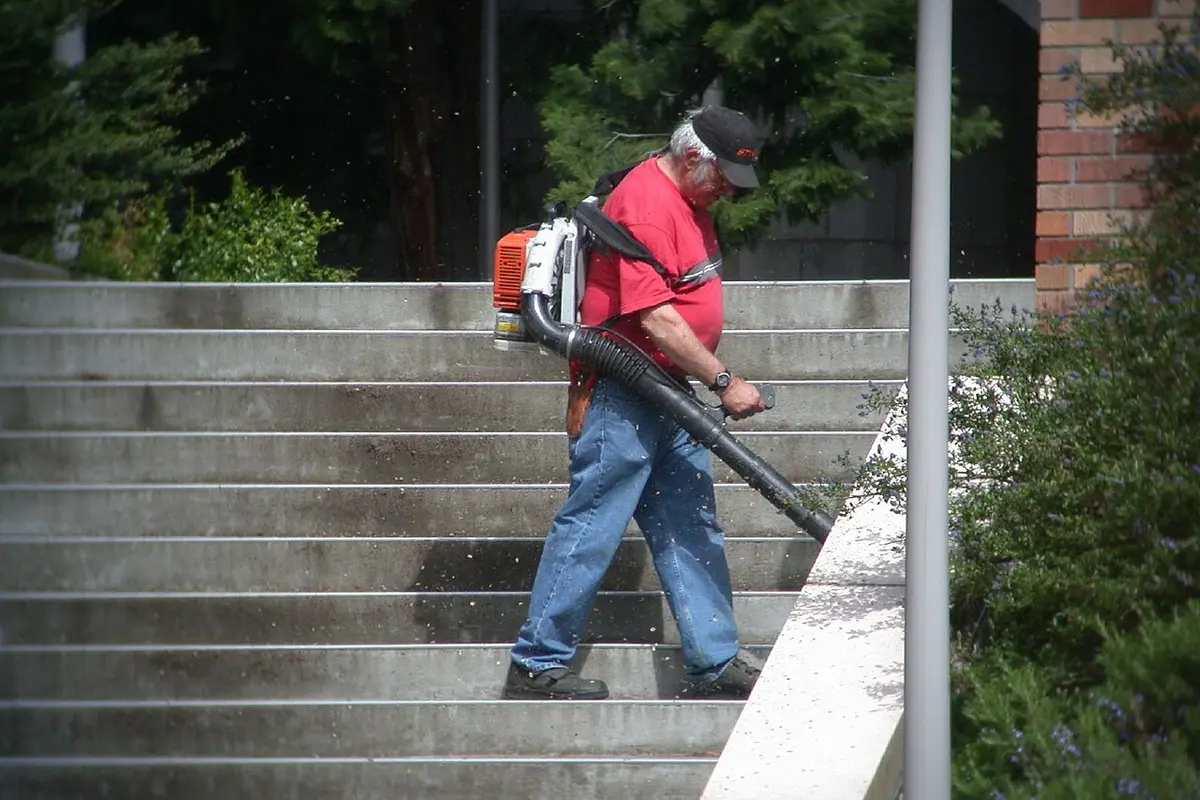
Photo: Man with leaf blower, Seattle by Josh Larios, via Wikimedia Commons, CC BY-SA 2.0.
The shelf of gutter cleaning tools in a hardware store runs from a simple plastic scoop to poles, wands, vacuums and blower kits that cost real money. Most homes need very few of them. This guide sorts the hand tools and ground tools that earn their place from the gear that sounds clever and then sits in the garage. It covers what each tool does, where it works, and where it stops working, so you can build a small kit that handles your roofline instead of collecting a large one that handles nothing better.
The tools worth owning are few: a plastic scoop, a bucket, work gloves and eye protection, a garden hose with a nozzle, and a telescopic pole with scoop and tong heads for ground work. That short kit clears most homes. Everything past it is a speed upgrade, not a requirement.
Think in jobs, not products. The jobs are: lift the load out, reach what your hands cannot, rinse the fine grit away, flush the downspouts, and protect yourself while you do it. A scoop handles the lifting. A pole with changeable heads handles the reach. A hose and nozzle handle rinsing and flushing. Gloves and eye protection handle the safety side. Any tool that does not serve one of those five jobs is probably decoration.
Quality matters most where force is applied. A scoop should flex a little without snapping, pole sections should lock tight with no wobble, and hose fittings should be metal, not thin plastic that cracks in its second winter. The cheap version of a tool you use twice a year still gets used for a decade, so one solid kit beats three flimsy ones.
The gutter scoop is the core hand tool, and plastic beats metal. Its shape matches the channel floor, it lifts a full load per pass, and it will not strip the coating that keeps the metal from rusting. A narrow garden trowel works in a pinch but scrapes and digs, so keep it for the garden.
A hose with an adjustable nozzle finishes the hand kit. On a jet setting it rinses the channel floor and tests slope, since water should travel toward the outlet at about 1/4 inch per 10 feet. On the same setting, pushed into a downspout opening, it tells you in seconds whether the pipe runs clear.
Ground work runs on the telescopic pole. Buy the pole for its locks and its head fitting, because the same pole should carry a scoop for dry leaves, tongs or a grabber for the wads packed behind hangers, and a brush for a final sweep. Pole kits sold as one fixed tool do one job. A pole with swappable heads does the whole roofline.
A gutter wand connects to the hose and hooks over the channel edge, washing grit and fine sludge toward the downspout from below. It is a rinsing tool, not a digging tool, and it works best after the scoop pass. Vacuum tube sets pull dry leaves out cleanly but are heavy at full extension and clog on wet loads. For the powered option that pushes debris instead of pulling it, see our leaf blower gutter attachment guide, which covers fit, reach and limits in full. Blower gear sits in its own guide because it raises separate questions about power and roof shape.
Gloves come first. A full channel holds sharp metal edges, screws, wasp nests and grit that acts like sandpaper, so a firm work glove is the difference between a chore and a cut. Eye protection is second: scooping flicks sludge up and out, and one gritty splash in the eyes ends the session.
Footwear and ladder gear matter just as much. Shoes with a firm sole grip rungs; soft sneakers slide. A ladder stabilizer, the wide bar that rests against the wall, keeps the rails off the fragile channel and stops sideways sway. None of this gear is exciting, and all of it is cheaper than the clinic visit it prevents. If a kit listing skips gloves and eye protection to hit a price point, buy those two items separately before your first clean.
Skip the pressure washer wand for channel work. High pressure blasts sealant out of seams, lifts shingle edges, and sprays the load across the roof instead of out of the gutter. Skip metal scoops and sharp trowels for the scraping reason above. Skip single use gadgets with one fixed shape, like narrow hooks that only fit one profile of gutter, unless your home happens to match that profile exactly.
Be skeptical of any kit that counts a dozen pieces. Most of the count is adapters and duplicate heads. Two good heads, scoop and tongs, plus a brush, cover the jobs. Spend the difference on a better pole, since wobble at full length is what makes ground work tiring and sloppy.
A solid basic kit of scoop, pole, heads, wand, gloves and eye protection usually costs less than one hired visit, and it serves for years. That makes owning tools the smart spend for one and two story homes with ground you can stand a ladder on, or rooflines a pole can reach from the yard.
Hired cleaning for most homes runs $100 to $250 per visit, or $0.50 to $2.50 per foot. Any published range is a guide: the actual price for your home is set after measuring it and given as an itemized written quote fixed before work starts. When the home is tall, the roof is steep, or the downspouts block hard every year, the professional gutter cleaning service is the better buy, because the crew cost buys the height work and the downspout clearing your kit cannot do. Tools and crews are not rivals. Most owners end up with both, each used where it makes sense.
Full system cleaning with downspouts flushed, debris hauled away, and the price in writing before you book.
See prices and detailsThe ladder method in full, with the setup and work order that keep the job under control.
Read the guidePole tools, blower kits and hose wands that let you clear a channel with both feet on the lawn.
Read the guideHow blower kits fit, where they work well, and where wet sludge beats them every time.
Read the guideBrowse every guide on the Gutter Cleaning HQ blog, grouped by topic.
A plastic gutter scoop. It fits the channel, lifts a full load of leaves and sludge in one pass, and will not scrape the coating off the metal the way a metal trowel can. Paired with a bucket and a hose, it covers most of what a one story home needs each season.
Partly. Tongs and grabber heads pick out wads of leaves and the grit packed behind hangers better than a flat scoop can. A solid layer of wet sludge still defeats them, because there is nothing to grip. Loosen packed loads with a scoop first, then use tongs for the corners and the spots behind straps.
Match the scoop to the channel width. Most homes run a standard width channel, and a scoop made for that size slides along the floor without jamming against the sides. A scoop that is too wide rides up and leaves a strip behind. One that is too small doubles your passes. Check the product sizing against your gutter before you order.
Rinse everything, let it dry fully, and store poles collapsed in a dry corner of the garage or shed. Wet sludge left in a scoop or wand breeds mold and corrodes metal fittings over one winter. Hanging poles on wall hooks keeps the sections straight and the threads clean for the next season.
Book a full clean with the price in writing first: debris out, downspouts flushed, and before and after photos with your invoice.
Call +1 (888) 295-0648