Service
Downspout and Drain Cleaning
Blocked downspouts and buried lines flushed and tested, so extensions drain the way they should.
See prices and detailsA downspout that ends at the wall has done only half its job. The last few feet, across the soil beside the house, decide whether that water soaks your footing or lands clear.
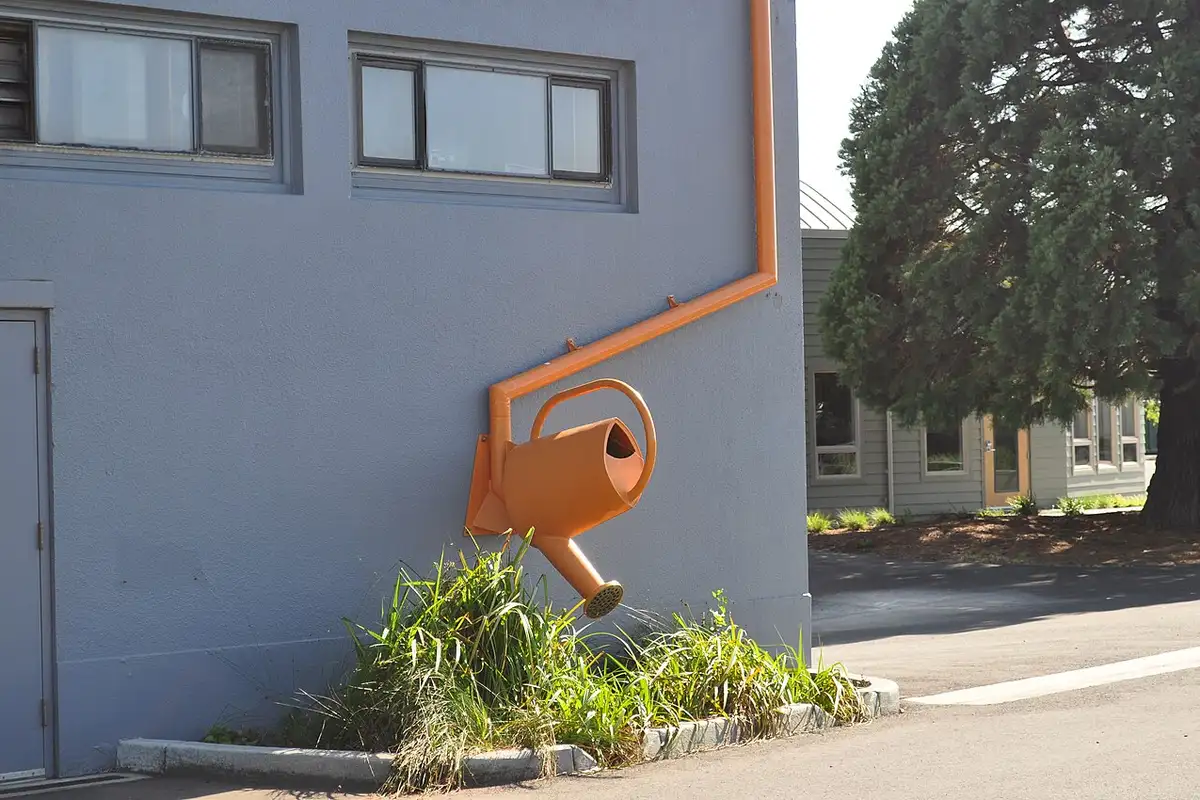
Photo: Anacortes - downspout on port building 02 by Joe Mabel., via Wikimedia Commons, CC BY-SA 3.0.
A downspout extension is the simplest fix in the whole drainage chain, and one of the most skipped. The gutter collects the roof water, the downspout brings it down the wall, and then, on many homes, it pours straight out at the base, exactly where it can soak the footing, wash out mulch and feed a damp basement. Adding a few feet of pipe at ground level moves that discharge to soil that can take it.
An above ground extension moves the discharge point away from the house, so water lands where soil can take it. Rigid pipe holds its shape best, flexible pipe bends around beds and paths, and folding and roll out types clear the mower. Four to six feet from the wall is the working distance.
Rigid extensions are straight lengths of smooth pipe, in plastic or aluminum, fixed to the bottom elbow with screws. They hold their line, shed grit instead of trapping it, and stand up to boots and mower bumps. Their limit is shape: a rigid run goes straight, so beds, steps and paths in the way mean extra elbows or a different type.
Flexible extensions are corrugated pipe that bends by hand and stretches longer or shorter. A flex downspout extension is the fastest fix in the group, and the one to pick when the discharge has to curve around a shrub bed or a corner. The trade is inside the pipe: the ridges slow the flow and hold grit, so flex runs need a rinse or a shake out from time to time.
Long runs are possible with any type by joining lengths, but every joint above ground is a place grit can catch and frost can split. If a run needs to travel far, cross under a path, or leave the yard tidy for good, that is the point where owners usually stop extending above ground and start thinking about a buried line instead.
The working target is 4 to 6 feet from the foundation, onto ground that falls away from the house. Four feet is the line below which most discharge still finds its way back to the footing soil in wet weather. Six feet puts the water past the backfilled soil beside most houses, which is looser and drains faster than undisturbed ground.
Distance alone is not enough if the yard fights you. An outlet that ends on flat or uphill soil just moves the puddle, it does not remove it. Read the ground first: the discharge should land on a slope, however gentle, that carries it onward. Where the whole lot is flat, a longer run to the lowest corner of the yard beats a short run to soil that holds water for days.
Keep discharge off walkways, driveways and steps, where winter water turns to ice, and off a neighbor lot line. Also keep it clear of septic areas and well heads where local rules apply. A few minutes with a hose, watching where test water actually travels, tells you more than any measurement.
Fitting is a short job with hand tools. First, check the bottom elbow: the shoe should point away from the wall along the line the water needs to travel. If it points sideways or into a bed edge, turn it or swap it before adding length. A poor first direction makes every later foot work harder.
Measure the run from the elbow to your chosen discharge point, following the ground, not cutting corners through the air. Cut or stretch the pipe to length, slide it firmly over the elbow, and fix it with one or two short screws so wind and mower bumps cannot walk it off. Set the far end on soil or a flat stone, with the mouth clear and pointing downslope.
Finish with a hose test. Run water into the gutter above, watch it arrive at the outlet, and check three things: no leaks at the elbow joint, no backing up at the mouth, and the discharge landing where you planned. Small fixes are easy now. They are annoying after the bed is replanted over the pipe.
The most common fault is a flat or uphill lay. Pipe that dips in the middle holds water after every rain, and that standing water grows algae, draws insects and freezes in winter, splitting seams. Lay the run with a steady fall along its whole length, and support a long flex run so it cannot sag between stones or bed edges.
The second fault is a crushed or kicked pipe that nobody notices. Above ground pipe lives where feet, wheels and toys travel. A flattened section slows the flow, backs grit up into the elbow, and can plug the downspout in one heavy storm. Walk the lines each fall when you clean the channels, squeeze out dents where you can, and swap lengths that no longer hold their shape.
The third fault is a mouth buried in mulch or soil. Mulch migrates, soil washes, and an outlet that was clear in spring can be capped by fall. Keep the mouth visible and open, and cut it back a little rather than letting it discharge into a mulch dam of your own making.
Sometimes the pipe at ground level is fine and the problem sits deeper: the downspout itself is plugged, or an older buried line leaving the wall has silted shut. The signs are water backing up at the bottom elbow, overflow at the top of the downspout, or a discharge that slows to a trickle in steady rain. No length of new pipe at the surface fixes a blockage below it.
Clearing that kind of fault, as part of a repair or cleaning visit, sits in the published repair range of $100 to $450 per job, depending on access and how much line needs flushing. Read that range as a guide for planning. The actual price for your home is decided after the lines are tested, and it should come to you as an itemized written quote fixed before work starts. Our downspout and drain cleaning service page explains how blocked lines are flushed and proven clear.
Judge your own yard with a simple rule. If water lands 4 to 6 feet out, on falling ground, and the pipe runs clear in a hose test, an above ground fix has done its job. If any of those three fail, the next step is below ground, not a longer pipe on the surface.
Blocked downspouts and buried lines flushed and tested, so extensions drain the way they should.
See prices and detailsPipe choice, slope and outlets for lines that carry water underground to daylight.
Read the guideThe simple block that spreads discharge water and saves soil and mulch at the wall.
Read the guideSpacing and size rules that decide how much roof one downspout can serve well.
Read the guideBrowse every guide on the Gutter Cleaning HQ blog, grouped by topic.
Long enough to drop the water on ground that falls away from the house, which for most yards means 4 to 6 feet from the wall. Shorter runs dump water beside the footing. Much longer above ground runs get in the way of mowing and walking, which is the point where a buried line starts to make more sense.
It can, but it is rarely a good idea. Water crossing a path in winter can freeze into a slick patch exactly where people walk, and a pipe across a walking line gets kicked, tripped on and crushed. Route around paths where you can, or lift the discharge over the path and drop it on the far side.
It can. The ridges inside corrugated pipe slow the flow and catch shingle grit and seeds, so a flex run needs a shake out or rinse now and then. Smooth rigid pipe sheds grit better. If your roof sheds heavy grit, check a flex run each fall when you clean the channels.
Roll out types are made to unroll under water pressure and lie flat when dry, and most owners mow over them without trouble once they sit flat. The catch is that a curled or lifted end catches mower wheels and feet. Check the lay after storms, and replace one that no longer sits flat.
Tell us where each downspout ends now. We will say whether a simple extension fixes it or the line below needs cleaning, and quote it in writing.
Call +1 (888) 295-0648