Service
Downspout and Drain Cleaning
For buried lines that have silted or blocked and will not clear with a hose from the cleanout.
See prices and detailsBurying the discharge line keeps yards clear of pipes and moves roof water well away from the house, but only if the line is built with fall, solid pipe and a way back in for cleaning.
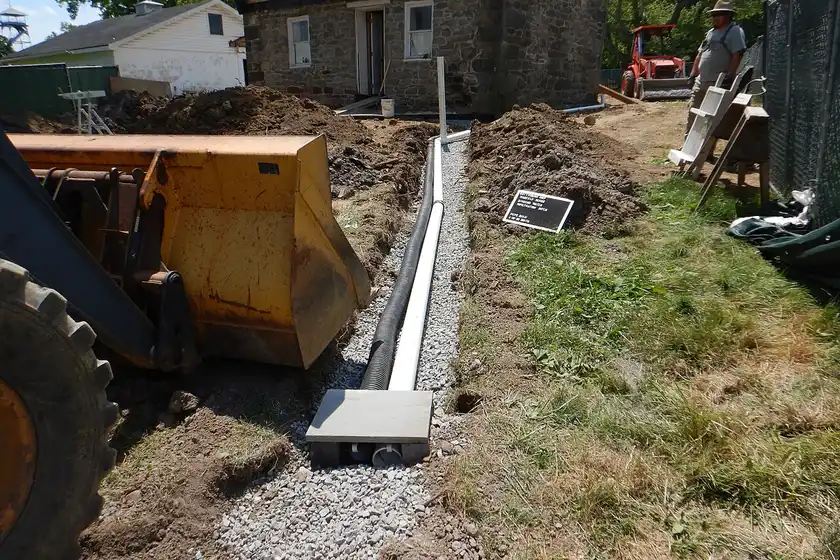
Above ground pipe solves the discharge problem for many homes, but it crosses lawns, paths and beds, and some yards have nowhere good for water to land within a few feet of the wall. That is where downspout drainage goes underground: the downspout turns into a buried line at the base of the wall, carries roof water under the yard, and lets it out well away from the house. This guide explains how a sound buried line is built, in DIY terms.
A buried line takes water from the downspout base, carries it underground in solid pipe laid with a steady fall, and lets it out at a pop up emitter or open outlet well away from the house. Done well it stays clear for years. Done flat, it silts up and freezes.
A buried line has five pieces, and none of them is fancy. At the wall, an adapter or catch fitting takes water from the bottom of the downspout into the underground pipe. The pipe itself runs in a trench across the yard. A cleanout tee near the wall gives access for flushing later. At the far end, the line finishes at a pop up emitter in the lawn or an open daylight outlet on a slope. Gravel or washed stone under and around the outlet helps the discharge spread without digging a hole.
The order of work matters more than the materials. Plan the route first, from outlet back to the wall, so the fall works with the ground you have. Dig the trench deeper at the wall and shallower toward the outlet, following your planned line, not the other way round. Lay and join the pipe, test the whole line with a hose before any soil goes back, then backfill in layers and firm each one down.
Before any digging, call the local utility marking service, 811 in most of the United States, and have buried cables and pipes marked. A trench for a drain line crosses the same ground as water, gas and data lines on many lots, and finding one with a spade is a bad day by any measure.
Use solid pipe for a roof water line. Smooth bore solid pipe, in 3 inch or 4 inch sizes, moves a storm flow fast and gives grit little to catch on. The 4 inch size is the common pick where a downspout serves a large roof area, because it keeps capacity in hand when leaves and grit ride along with the water.
Corrugated solid pipe bends easily around roots and rocks, which makes trenching simpler, but its ridges slow flow and hold silt. It works, and many yards use it, yet it needs the cleanout more than smooth pipe does. Perforated pipe is a different tool altogether: its holes are made to collect ground water along a trench, which is the job of a french drain. A downspout french drain setup joins the two ideas where one trench handles both roof water in a solid line and ground water in a perforated line beside it. Keep the two flows in separate pipes, or the roof flow will push out through the holes and soak the trench.
Joints decide whether a buried line stays a line. Push fittings fully home, use proper adapters where pipe sizes change, and never let an open joint sit in the trench hoping soil will seal it. Soil does the opposite: it washes into open joints, grain by grain, until the line runs half full of sand.
Fall is the whole game underground. Aim for a steady fall of at least 1 inch over every 8 feet of run, with no flat spots and no reverse dips. A line that starts steep and runs flat at the end silts up at the change of pace. A line with a belly in the middle holds water in that belly forever, and in cold weather that held water is where the freeze starts.
Depth follows climate and use. The line must sit below the turf and out of reach of aerators, edging tools and shallow planting. Where winters freeze hard, deeper burial keeps the line below the worst of the frost, and a line that drains fully dry after each storm has little water left to freeze in the first place. Good downspout drainage is dry drainage between rains: fall, smooth pipe and a clear outlet all serve that one goal.
At the outlet, give the water somewhere honest to go. A pop up emitter in a lawn should sit where the discharge can spread and soak in, not beside a path where it can freeze. A daylight outlet on a slope needs its mouth held open with stone, clear of soil and mulch, and pointed so the flow runs away across the surface rather than cutting a gully back toward the house.
Most buried clogs start at the top, not underground. Leaves and shingle grit that pass the gutter outlet ride into the line and settle at the first bend or flat spot. A simple strainer or leaf catcher where the downspout meets the buried line stops the big material, and it takes a minute to empty during each gutter clean. That one fitting prevents most of the silt a line would otherwise collect.
The cleanout earns its trench space the first time you need it. Fit a tee with a capped riser near the wall, at ground level, so a hose or small auger can reach the full run. Flush the line once a year, in fall after the leaves, and note how the flow at the outlet looks. Strong and clear is healthy. Slow and muddy means silt is building, and an extra flush now beats a blocked line in a spring storm.
Freeze faults follow a pattern: a flat or dipped section holds water, the water freezes, and the next storm backs up at the wall and spills at the base. The fix is not heat or chemicals. It is regrading that section with proper fall during a dry spell, so the line empties fully after each rain.
As a DIY job, a buried line is mostly digging. The materials are pipe, fittings, a strainer, a cleanout and an emitter. The labor is a trench with steady fall, which is slow work by hand and faster with a rented trencher where the lot allows one. Fit owners with a helper, a free weekend and a simple straight route do this job well. Long routes, roots, rock and lines that must pass under paths or drives are where the job grows teeth.
Where a buried line already exists and has blocked solid, clearing it is a different task from building one. A crew visit to rod and flush a silted line sits in the published repair range of $100 to $450 per job, depending on length and access. Read any published range as a guide. The actual price for your home is decided after the line is tested, and it should reach you as an itemized written quote fixed before work starts. Our page for blocked downspouts and buried lines sets out how that testing and clearing visit works.
End with the hose test, whether you dug the line yourself or had help. Run water at full flow into the top of the downspout for several minutes. It should arrive at the outlet strong, run clear after the first flush of dust, and leave no soft, sinking ground along the trench line. Pass that test and the yard is yours again, with the water leaving quietly underground.
For buried lines that have silted or blocked and will not clear with a hose from the cleanout.
See prices and detailsAbove ground options compared, for yards where a surface run solves the problem simply.
Read the guideThe simple block that spreads discharge water and saves soil and mulch at the wall.
Read the guideSpacing and size rules that decide how much roof one downspout can serve well.
Read the guideBrowse every guide on the Gutter Cleaning HQ blog, grouped by topic.
It is the wrong tool for roof water. Perforated pipe is made to leak water out along its length and to collect ground water, which suits a yard drain. A roof line should move a heavy flow from one point to one outlet without soaking the trench, so use solid pipe and save perforated pipe for ground water jobs.
Deep enough to sit below turf and roots and out of the way of garden work, and deeper where hard freezes reach, so trapped water is less likely to freeze solid. Many owners bury lines around a foot down in mild areas and deeper in cold ones. Follow local practice for your area, and keep the fall steady at whatever depth you choose.
Two endings work well. A daylight outlet opens on a slope where water can run off across the surface, and a pop up emitter sits flush in a lawn and lifts under water pressure, then closes when the flow stops. Pick the ending that keeps discharge away from paths, beds that flood easily, and the lot line.
Start at the cleanout if one was fitted, or at the low outlet, and work a hose or a small drain auger up the line while water runs. Flushing from the top down pushes silt toward the open end. If the line has no cleanout and will not clear, that is the point where a crew with proper rodding and flushing gear earns its fee.
Describe the run and where the water needs to end up. We will talk through the route in plain terms and quote any cleaning work in writing first.
Call +1 (888) 295-0648