Service
Gutter Guards Service
Fitting, types and published prices for covers matched to your trees and roof.
See prices and detailsSeven guard families sit on store shelves, and they work in very different ways. Here is what each one stops, what it lets through, and what it asks of you in upkeep.
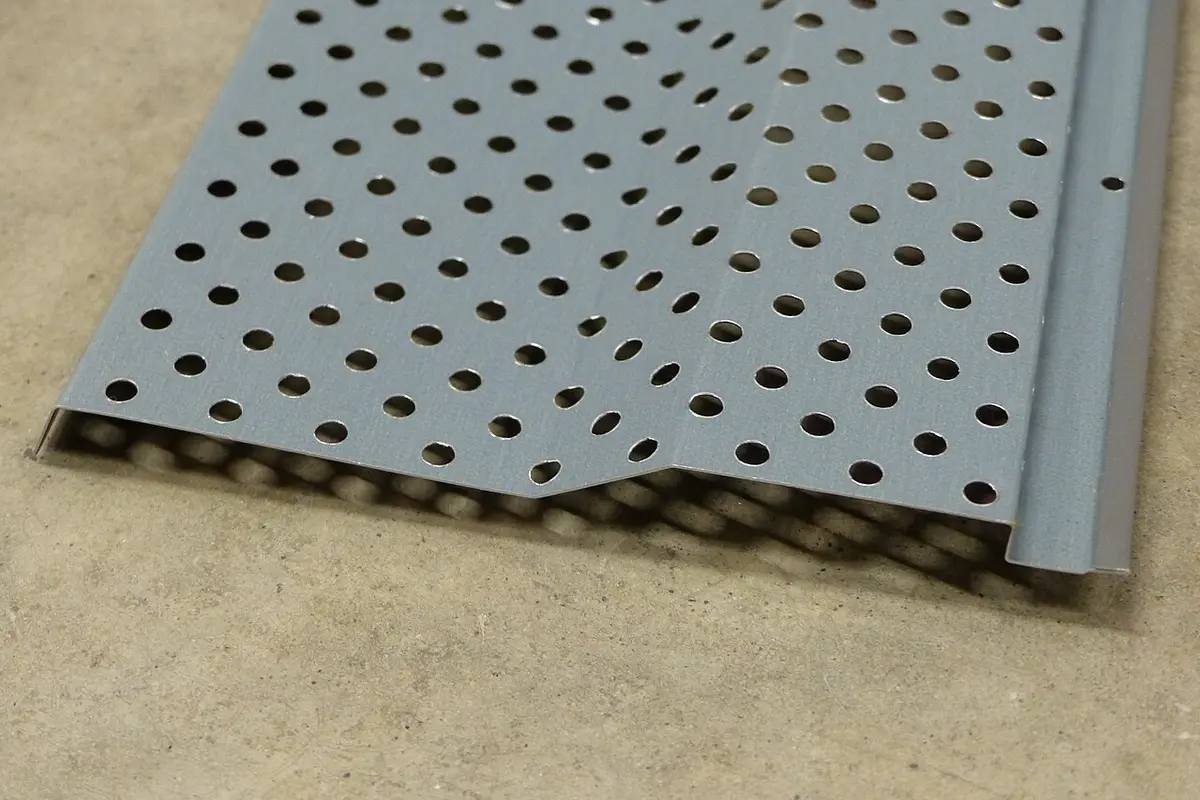
Photo: Gutter Guard 07 by Stilfehler, via Wikimedia Commons, CC BY-SA 4.0.
Walk into any home store and the shelf suggests one product with seven labels. In truth the types of gutter leaf guards split into seven families that work in genuinely different ways, and picking by price alone is how owners end up with needles in the channel or water shooting over the edge. This guide walks each family in turn: how it works, what it stops, what it misses, and how much upkeep it still needs.
Screens are the cheap, simple option. Mesh stops more and lasts longer. Micro mesh stops the most, including most pine needles and shingle grit. Brush and foam are easy to fit but fill up fastest. Surface tension covers shed leaves well but can overshoot in heavy rain. Hybrids mix two ideas to cover each weak spot.
Every guard makes the same bargain: openings small enough to block debris will also slow water, and openings large enough for any storm will let some debris in. The families differ in where they strike that bargain. Hole size is the first number to look at. A screen hole you can see through clearly passes seeds. A micro mesh opening you can barely see stops grit but needs a frame to stay flat. The second thing to look at is how the product meets fast water, because a valley in a storm delivers more water in a minute than most covers are tested with.
Price follows the same ladder. For screen and mesh guards, published fitting prices run $6 to $13 per foot, and brush and foam sit at or below the bottom of that range when owners fit them by the box. A published range is a guide, not a quote for your home. The actual price is decided after measuring the home, and it should arrive as an itemized written quote fixed before work starts. If you want fitting handled for you, our gutter guards service page covers the options and prices in one place.
Screen guards are panels of metal or plastic with round or diamond holes, clipped to the gutter lip or slid under the shingles. They stop whole leaves well and cost the least. They miss seeds, needles and grit, and thin plastic versions warp in hot sun and dip into the channel. Metal screens hold up better. Cleaning means lifting panels and scooping what passed through, usually every year or two.
Mesh guards use a finer woven or expanded metal surface, often on a frame. The smaller openings stop most seeds and short needles as well as leaves, and a framed panel stays flat instead of sagging. Mesh is the middle choice most owners end up with: good blocking, fair price, and moderate upkeep. Debris sits on top and mostly dries and blows off, though shaded roofs keep it damp and matted.
Micro mesh guards use a very fine stainless mesh over a rigid frame. The openings are small enough to stop shingle grit and most pine needles, which no other flat design manages. The costs are price at the top of the range, a frame that must be fitted carefully at corners, and a surface that can slow very heavy rain on steep roofs. For pine heavy yards, this is usually the family that ends the argument.
Brush guards are long cylinders of stiff bristles that sit inside the channel like a bottle brush. Leaves land on top and mostly blow away, while water flows through the bristles below. Fitting could not be simpler: cut to length and drop in. The weakness shows in year two and three. Seeds and grit settle down into the bristles, small plants can root in the brush, and the whole insert must come out for a shake and wash far more often than the box suggests.
Foam guards are triangular foam blocks that fill the channel, leaving water to pass through the foam itself. They are light, cheap and easy to trim. They are also the shortest lived family here. Foam soaks up seeds, holds moisture against the metal, breaks down under sun at any exposed edge, and can sag below the lip where it starts catching the very debris it was meant to shed. Foam suits a small, dry, lightly treed roof for a few seasons. It does not suit a wet oak canopy.
Surface tension guards, often called reverse curve covers, are solid hoods with a curved front edge. Rain clings to the curve and follows it into a narrow slot, while leaves slide off the smooth surface and fall. When the roof pitch and flow suit them, they shed debris better than any screen. When rain comes too fast, on steep roofs or under valleys, water breaks free of the curve and overshoots the slot entirely. Fit is everything, and the cover fixes to the roof edge, which some owners and some shingle warranties dislike.
Hybrid guards combine two ideas, most often a framed micro mesh panel with a raised or louvered front section, or a screen set over a solid diverter at valleys. The point is to cover a known weak spot: the hybrid takes the fine blocking of mesh and adds help where water arrives fastest. Hybrids cost more than plain mesh and vary a lot from maker to maker, so judge the sample in your hand: frame stiffness, mesh fineness, and how the panel will sit at a corner.
Match the family to your debris first. Whole leaves only: a metal screen or plain mesh does the job for the least money. Seeds and grit in the mix: move to framed mesh. Pine needles: micro mesh, or accept regular cleaning instead. Then match to your water. Steep roofs and big valleys punish flat screens and pure surface tension covers, so framed designs with a solid front edge behave better there.
Last, be honest about upkeep. Every family on this page still needs the cover brushed and the channel checked on a cycle, just a longer and lighter one than an open gutter. The gutter screen vs gutter guard debate in store aisles is really this same choice in disguise: how fine, how framed, and how fitted. Pick the family that fits your trees and your roof, and the brand question gets much smaller.
Fitting, types and published prices for covers matched to your trees and roof.
See prices and detailsThe honest sum: what guards save in cleaning and what they never stop.
Read the guideA plain method for judging mesh, frame, fit and warranty before you spend.
Read the guideBrowse every guide on the Gutter Cleaning HQ blog, grouped by topic.
Brush and foam inserts are the simplest, since they drop into the channel with no screws or cutting. Basic screens come next, clipping or sliding under the first row of shingles. Framed mesh and surface tension covers take measuring, cutting and fastening, and a bad fit at corners and valleys is where most home fitted jobs fail.
Yes, but the fit changes. Metal panels shed water faster than shingles, so a flat screen can let heavy rain overshoot. Framed mesh with a solid front edge and curved surface tension designs handle fast water better. Whatever the type, the panel must fasten to the gutter lip or fascia, not be forced under metal roofing.
Owners do it more often than installers admit. A common pattern is framed mesh on the long straight runs and a surface tension cover under a heavy valley, where flow is strongest. Mixing works when each section is chosen for the water and debris it actually faces, not when leftover panels get used up at random.
Water spilling over the edge in moderate rain, plants sprouting along the line, and a cover that sags or lifts at the seams are the clear signs. Brushes and foam fail quietly by filling with seeds and grit until they hold water instead of shedding it. Lift one panel a year and look at the channel beneath.
Tell us what grows over your roof and we will match the guard family to it, with an itemized written quote before any work starts.
Call +1 (888) 295-0648