Service
Gutter Guards Service
Fitting, types and published prices for covers matched to your trees and roof.
See prices and detailsThis guide names no winners. Instead it gives you the five tests that separate a guard that works on your roof from one that only works in a showroom.
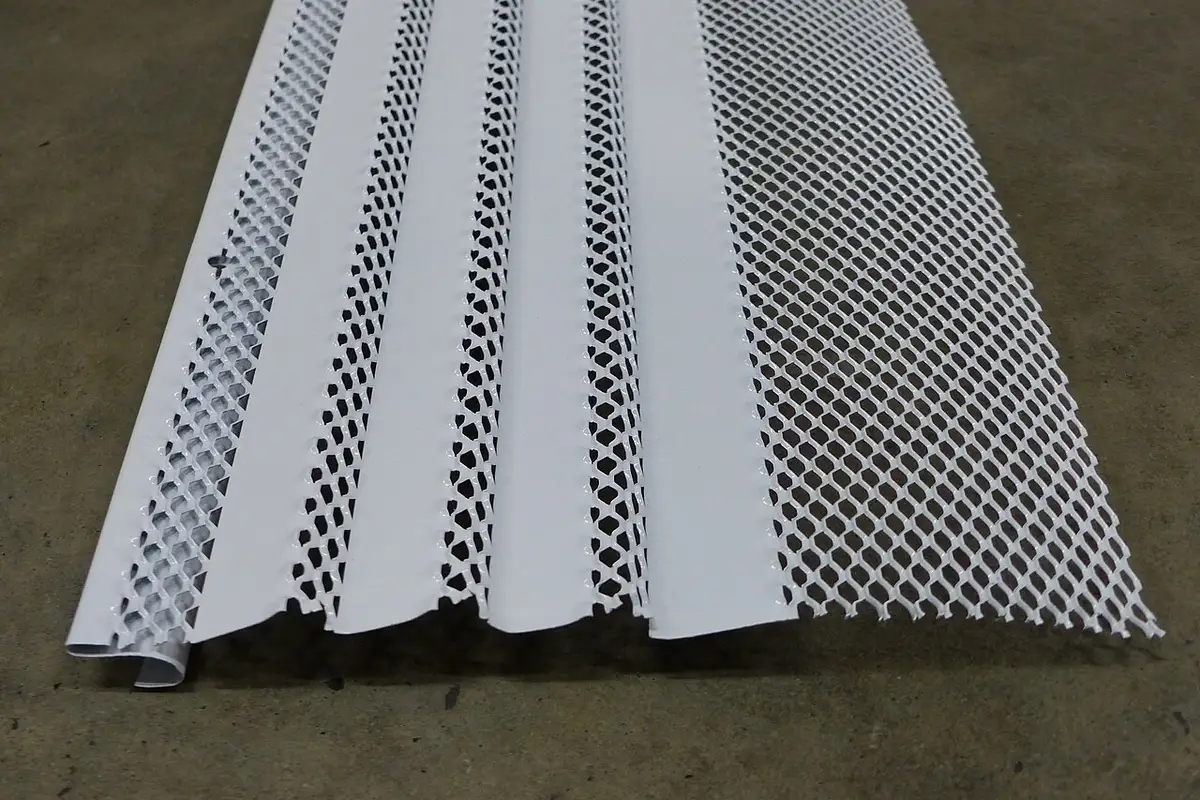
Photo: Gutter Guard 05 by Stilfehler, via Wikimedia Commons, CC BY-SA 4.0.
Search for the best gutter guards and you will drown in ranked lists that crown a different winner on every site, usually the one paying the highest commission. This guide takes the other road. It names no brands and ranks no products. Instead it teaches you to judge any guard the way an installer does: by mesh size, frame, roof fit, warranty terms and the installed price. Learn the tests and the marketing gets easy to see through.
The guards that earn the word best on a given home are the ones matched to that home: mesh fine enough for its debris, a frame stiff enough to stay flat, a fit that suits the roof edge and pitch, honest warranty terms, and an installed price that pays back in avoided cleanings within a few years.
Start outside, not in a store. What actually lands on your roof? Whole oak and maple leaves are easy to stop; almost any cover manages them. Maple seeds, locust pods and roof shingle grit are harder. Pine needles are the hardest common test, because they are thin enough to pass through coarse openings and stiff enough to stand upright in them and form a mat.
Judge the sample against your worst debris. If you can see clear daylight through the openings, seeds will pass. A woven micro mesh that looks almost solid stops grit and most needles, but it also slows water, which leads to the next test. Owners under pines should also ask the consumer reports gutter guards question in a smarter form: not which product won a lab test, but which mesh size won under needle fall. That framing turns top rated lists into something useful instead of a trophy shelf.
A guard lives outdoors for years, holding a flat plane against sun, snow load, falling branches and ladders leaned against the edge. Flex the sample. A frame that bends easily in your hands will sag in August heat and dip into the channel, where it catches debris instead of shedding it. Thin plastic grows brittle in sun. Powder coated aluminum and stainless mesh on a rigid frame hold their shape far longer.
Look at the edges too. Cut mesh with raw edges can lift and curl. Panels that lock to the front lip of the gutter and rest solidly at the back stay put in storms. Ask how a panel comes out for the cleaning that will still happen, because a guard that must be bent or unfastened along its whole length will be serviced less often, and everyone in the trade knows it.
Across homes that owners report being happy with years later, the same pattern shows up. The opening size matches the smallest debris on the lot. The frame is metal and stiff. The panel fits that roof edge without being forced under shingles in a way the shingle maker forbids. Corners and valleys got extra attention, often a diverter or a different panel where water concentrates. And the owner went in knowing cleaning gets lighter, not zero.
The unhappy stories share a pattern too. The guard was bought on a showroom claim, fitted the same way on every roof, and never checked again until overflow stained the siding. Notice that none of this is about brand. Two neighbors can fit the same product and get opposite results because one roof is a low pitch under maples and the other is steep under pines. Judging well means judging the match, and the match is visible before you spend anything.
Water speed decides whether a fine cover works or overshoots. On a low pitch roof, rain arrives at the gutter slowly and a flat micro mesh drinks it in. On a steep roof, the same rain arrives fast and can sheet across a smooth cover and off the edge, mostly in heavy storms and mostly at valleys, where two slopes pour into one short run.
So ask specific questions. How does this panel handle a valley? Is there a raised section, a louver or a diverter option? Does the fixing slide under the first shingle course, screw to the fascia, or clip to the gutter lip, and does your roof covering allow that method? A seller who cannot answer in plain words is selling a product, not fitting a roof. Our gutter guards service page explains how fitting choices are matched to roof types, with prices published up front.
For screen and mesh guards, the published installed band is $6 to $13 per foot, and serious micro mesh systems can sit above it. Get the total for your home in writing, then run the payback sum: what do you now pay, or risk on a ladder, per cleaning, and how many cleanings does the guard realistically remove each year? If the total pays back inside a few years and the upkeep left is light, the buy is sound. If a salesperson quotes a figure several times the band with a discount that expires today, walk away and get a second written quote.
On warranty, years are the headline and terms are the story. A published price range is a guide, and the same honesty applies here: the actual price for your home is decided after measuring it, and should reach you as an itemized written quote fixed before work starts. Warranty paper should say who does the work if a panel fails, whether labor is covered, and what upkeep you must do to keep the cover valid. Judge all five tests together and you will land close to the best gutter guards for your house, whatever badge is on the box.
Fitting, types and published prices for covers matched to your trees and roof.
See prices and detailsThe honest sum: what guards save in cleaning and what they never stop.
Read the guideSeven guard families compared by what each one stops, misses and needs in upkeep.
Read the guideBrowse every guide on the Gutter Cleaning HQ blog, grouped by topic.
No. Price buys a sturdier frame and finer mesh, which matter under pines and heavy leaf fall. On a lightly treed one story home, a modest framed mesh can perform just as well for years. What fails owners is a mismatch: fine covers on fast water, or coarse covers under fine debris, at any price.
Read what is covered, not just the number of years. Parts only cover is common and leaves you paying labor. Look for terms that cover the panel staying in place and performing, ask who honors the warranty if the installer closes, and get any no clog promise in writing with its conditions spelled out plainly.
Yes, and you should. Flex the frame, hold the mesh to the light to judge opening size, and run water over it from a bottle to watch how the surface handles flow. Bring a handful of your own yard debris, needles or seeds, and see what passes through. It is the cheapest test you will ever run.
After, if the roof work is close. Roofers remove and refit edge materials, and guards fitted first can get bent or buried under new shingles. Tell both crews about the plan so the guard fixing method does not clash with the shingle warranty. On a sound existing roof, order does not matter.
We will look at your trees, pitch and valleys, say which design fits and which does not, and leave an itemized written quote.
Call +1 (888) 295-0648