Service
Seamless Gutters Service
How seamless systems are formed, fitted and priced for homes, with measuring and written quotes.
See prices and detailsSeamless runs are formed on a machine in your drive, cut to the exact length of your roof. This guide covers what they cost, why they price above store bought lengths, and where the extra money actually goes.
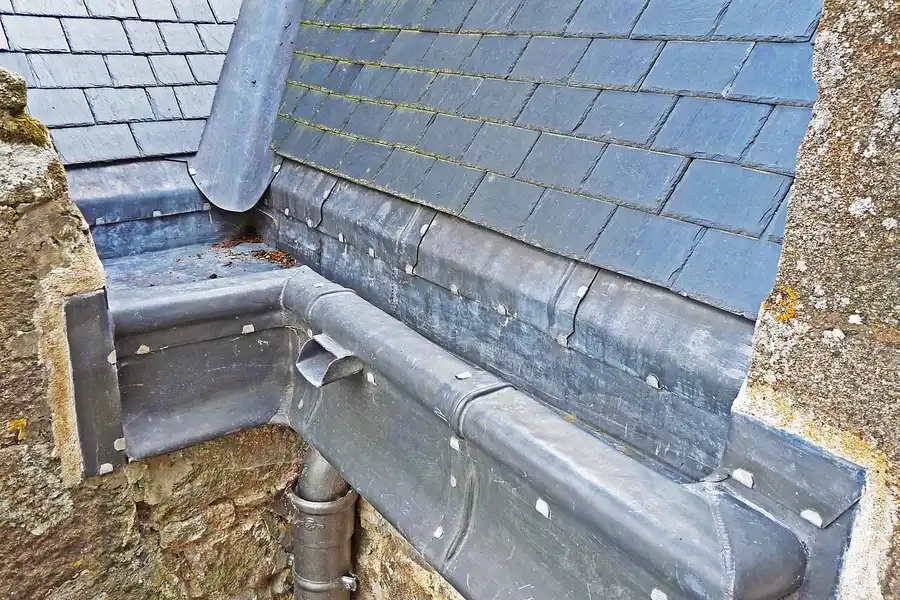
Photo: Chéneau, bande d'égout et noue en plomb. by Le plombier du désert, via Wikimedia Commons, CC BY-SA 3.0.
Homeowners comparing quotes quickly run into one puzzle: seamless gutters cost more per foot than the lengths sold in a home store, yet installers recommend them for most houses. The reason sits in how they are made and in how gutters fail. This page explains the seamless gutters price range, what drives a quote up or down, and how to judge whether the premium makes sense for your roofline.
Seamless gutters run $6 to $20 per foot in published guides, with most full home installs landing inside the wider $2,200 to $5,000 whole home range for new systems. The spread reflects home height, run length, gutter size and material. Long straight rooflines get the most value, since one formed piece replaces many joined lengths.
The cost to install seamless gutters is quoted per foot because the machine forms exactly the length your roof needs. Published guides put seamless work at $6 to $20 per foot. A simple one story home with long straight runs sits near the low end. A tall home with many corners, short runs and extra downspouts sits near the high end, because corners and outlets still take hand work even when the runs themselves are joint free.
Treat that range as a guide for planning. A published range cannot see your roof, and the actual price for your home is set after it has been measured, then provided as an itemized written quote that is fixed before work starts. If a quote for seamless work is given without a site measure, it is an estimate wearing a quote's clothes.
The average cost of seamless gutters for a whole home usually falls inside the standard new system range of $2,200 to $5,000. Owners asking how much do seamless gutters cost for their house should multiply their measured roof edge length by the per foot band, then add corners and downspouts as the quote lists them.
A seamless gutter starts as a flat coil of metal on a truck. A forming machine rolls it into shape on site and feeds it out in one continuous piece, cut to the inch. That machine, the truck, the trained crew and the heavier coil stock all sit inside the per foot price. Store bought sectional lengths carry none of those costs, which is why their shelf price looks lower.
The shelf price is not the installed price, though. Sectional systems need a joint every length, and each joint needs sealant, screws or rivets, and careful alignment. Labor adds up, and every joint stays in the system as a place where water can work its way out later. Seamless runs move the cost from joints to forming, and in exchange the finished system has joints only where they cannot be avoided: at corners and at downspout outlets.
That trade is the heart of seamless gutters pricing. You are not paying for a prettier word. You are paying to remove the most common failure point from most of the system.
None of these should be discovered after the truck arrives. A proper quote follows a measure and a fascia check, and it names the size, the downspout count and the corner count in writing. Our seamless gutters service page explains how the forming and fitting process works, so you know what the crew will actually do at your home.
Sectional gutters have one clear strength: they suit small jobs and confident DIY work. A homeowner can buy lengths, cut them with snips, and hang a short run over a porch in a weekend. For a full house, the balance shifts. Dozens of joints mean dozens of seals, and seals age, crack and let go one by one over the years.
Seamless systems shine on long, simple rooflines, which describe most suburban homes. They struggle to show their value on small or highly broken rooflines, where runs are short anyway and corners dominate. A good installer will tell you which kind of roofline you have, even when the answer points to the cheaper option.
Whichever you choose, the fitting standards stay the same: slope of about 1/4 inch per 10 feet toward the downspouts, hangers spaced to carry a full channel of water, and downspouts sized to the roof area. Water weighs about 8.3 pounds per gallon, so a long run holding storm water is a heavy thing, and spacing is not a detail to cut.
Owners who want a rough figure before calling can use a seamless gutters cost calculator style estimate at home: measure the roof edges, multiply by the $6 to $20 band, and treat the result as a budget range only. The written quote after measuring is the number that counts, and it is the number a good company will stand behind.
How seamless systems are formed, fitted and priced for homes, with measuring and written quotes.
See prices and detailsHow unit pricing works for installs and cleaning, and when a per foot quote helps you compare bids.
Read the guideWhen repair stops paying, what a full replacement runs, and how removal and disposal change the total.
Read the guideGuard pricing for screen and mesh systems, what fitting involves, and the upkeep to budget for after.
Read the guideBrowse every guide on the Gutter Cleaning HQ blog, grouped by topic.
For most homes with long straight runs, yes. Joints are where gutters leak, and a seamless run has joints only at corners and downspout outlets. That means fewer seals to fail and less upkeep over the years. On a small home with short runs, the gain is smaller, and well fitted sectional gutters can be a fair value. The roofline, not the sales pitch, should decide.
Yes. The forming machine on the truck rolls the gutter out in one piece cut to the exact length of your roof edge, which is the whole point of the system. Corners are still joined with miters, and downspout outlets are cut on site. Very long runs may need an expansion joint, which a good installer will point out during measuring.
The common sizes are 5 inch and 6 inch K style, with half round profiles also available from many installers. A 5 inch run suits most roofs. A 6 inch run holds more water and pairs with larger 3 by 4 inch downspouts, which suits steep roofs and large roof areas that shed heavy water in storms. Your installer should size the run to the roof, not to habit.
They need less joint maintenance, since there are far fewer seams to reseal. They still fill with leaves and grit like any open channel, and they still need cleaning on the same twice a year rhythm as other gutters. Owners sometimes hear that seamless means maintenance free. It does not. It means fewer leak points, which is a real but narrower benefit.
Start with a measured, itemized written quote. We form runs on site, fix the price before work starts, and show you exactly what each foot buys.
Call +1 (888) 295-0648